The meaning is the mouth
July 2026
Brands often talk about culture as if it lives only in language, symbols or visual identity. But culture is encoded in products too: in texture, pacing, ritual, intensity and residual emotional impacts. That matters especially when products move across markets, because the challenge is no longer just to communicate a message. It is to understand what a product already means, sensorially and socially, and how that meaning might be translated for a new audience with care.
This is where sensory semiotics becomes powerful. When we encounter a product outside our own cultural frame of reference, we are forced to listen differently. We pay closer attention to what the product is doing through the mouth, the hand, the sequence, the sensation. That can be incredibly generative. It allows us to separate surface codes from deeper human truths, and to think more clearly about what should be preserved, what can be adapted, and what new possibilities might emerge through respectful transcreation.
Chinese snacks offer a particularly rich innovation exercise here, not because they should be copied wholesale, nor because they represent a single, uniform tradition, but because they make sensory meaning unusually visible. They show how reassurance, care, ceremony, intensity or play can be built into the product experience itself. The opportunity for brands is not to turn those cues into exotic novelty. It is to understand the underlying logic and translate it into new contexts with embodied sensitivity.
Culture in practice
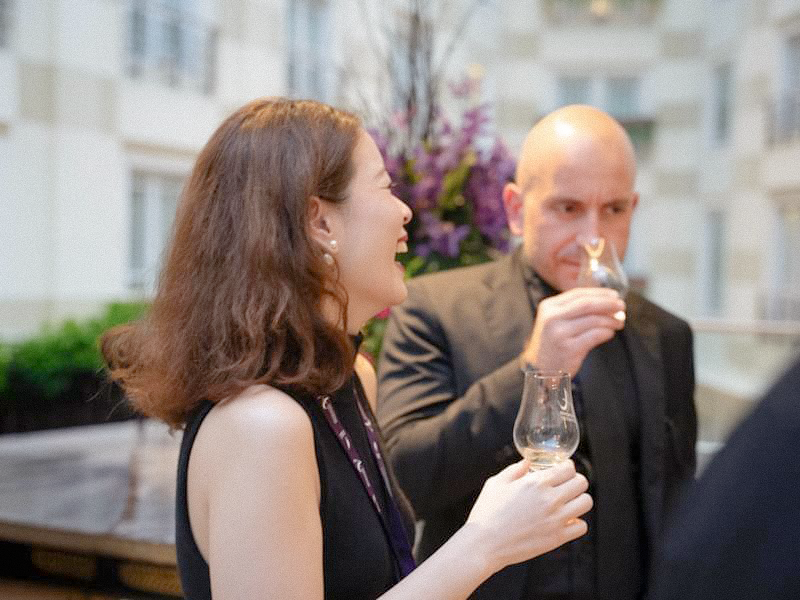
Huxly’s top semioticians, Coco Wu and Megan Bourner-Powell recently ran a sensory semiotics session both at Semiofest, the biannual international semiotics conference. They immersed participants in the sensory semiotic codes of indulgence in Chinese snacking to demonstrate the power of a semiotics lens in practice.
Amidst all the fun consuming musical lollipops and investigating novel textures, the deeper message and intention was to ask everyone to first: listen deeply to how our bodies were responding to these new sensations (without over-analysing or interpreting) – and secondly, ask ourselves what has to stay true about this product experience to have the same sensory response in a new context and what feels replaceable/adaptable for that new reality?
We then imagined how these products could show up in a speculative future where our relationship with snacking is transformed. We considered the job-to-be-done and occasion, and re-built the sensory experience based a sensory change and a cultural addition that would satisfy new needs and tensions. The results of these discussions were brilliantly inventive, so we wanted to share a couple of examples.
Scenario One: Snacking in a world of overstimulation
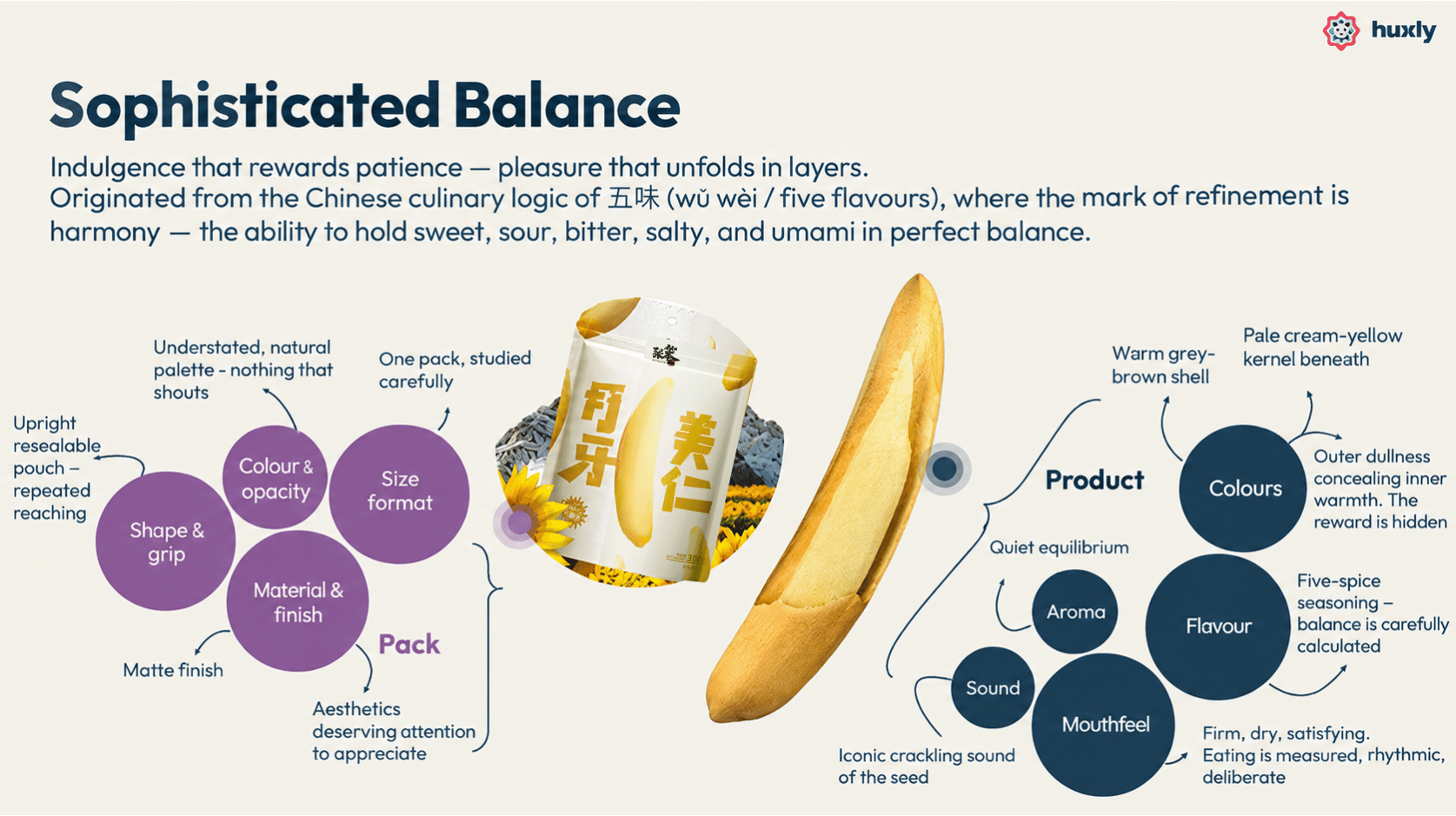
The starting code: Sunflower seeds with carefully balanced seasoning to represent Sophisticated Balance, where pleasure unfolds in a very subtle yet intentional way
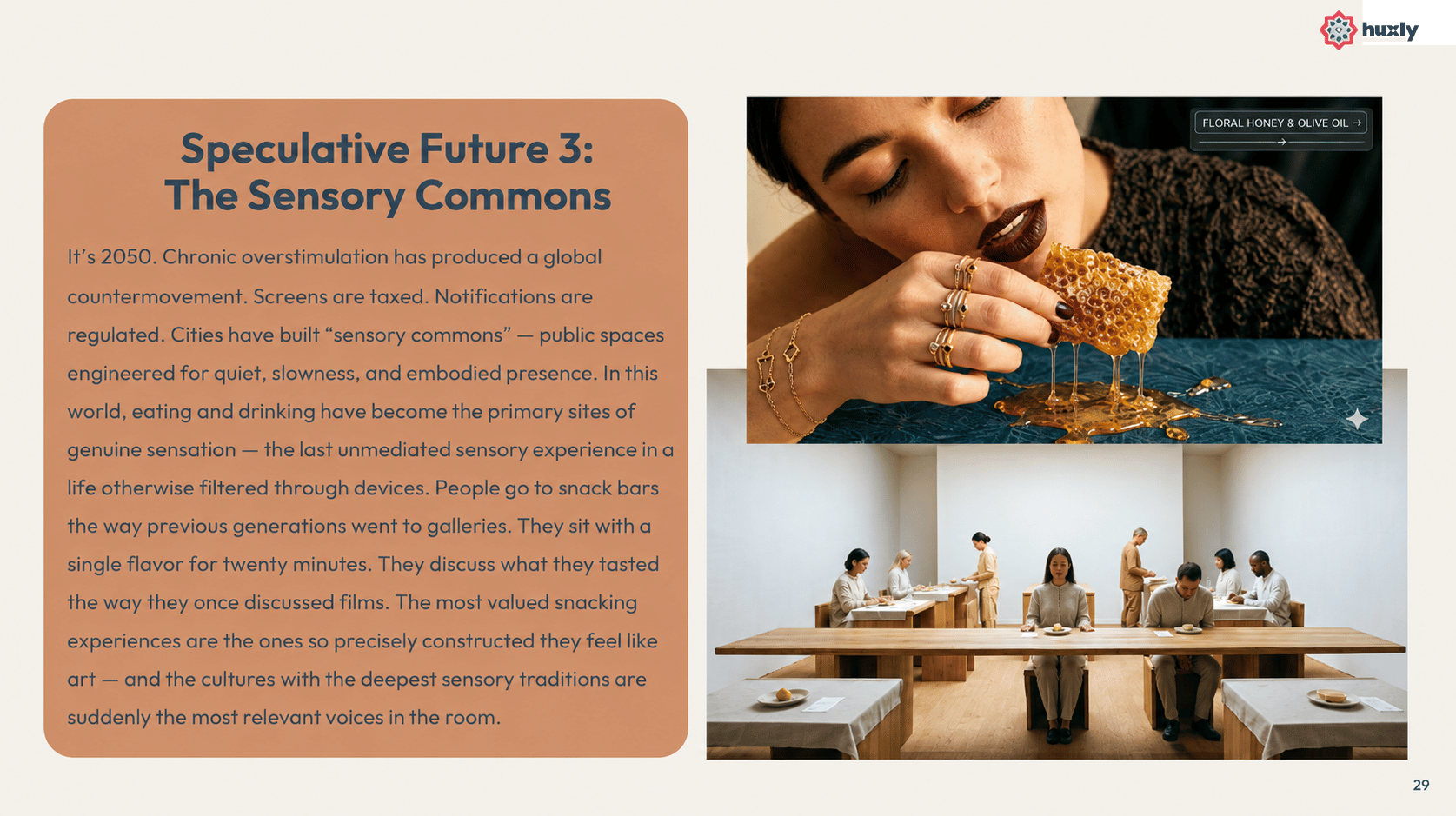
The chosen speculative future:
The proposed solution:
In a world where friction-maxxing is not only an antidote to screens but part of a concerted effort to tackle an epidemic of chronic overstimulation, the role of snacking is to create restorative sonic and tactile rituals. First, is a communal sonic rhythm of sunflower seed eating, biting, crunching and chewing in unison to feel connected. This is followed by artistic arrangement of seeds into a mosaic-like composition to still the mind.
Scenario Two: Snacking to preserve maternal connection
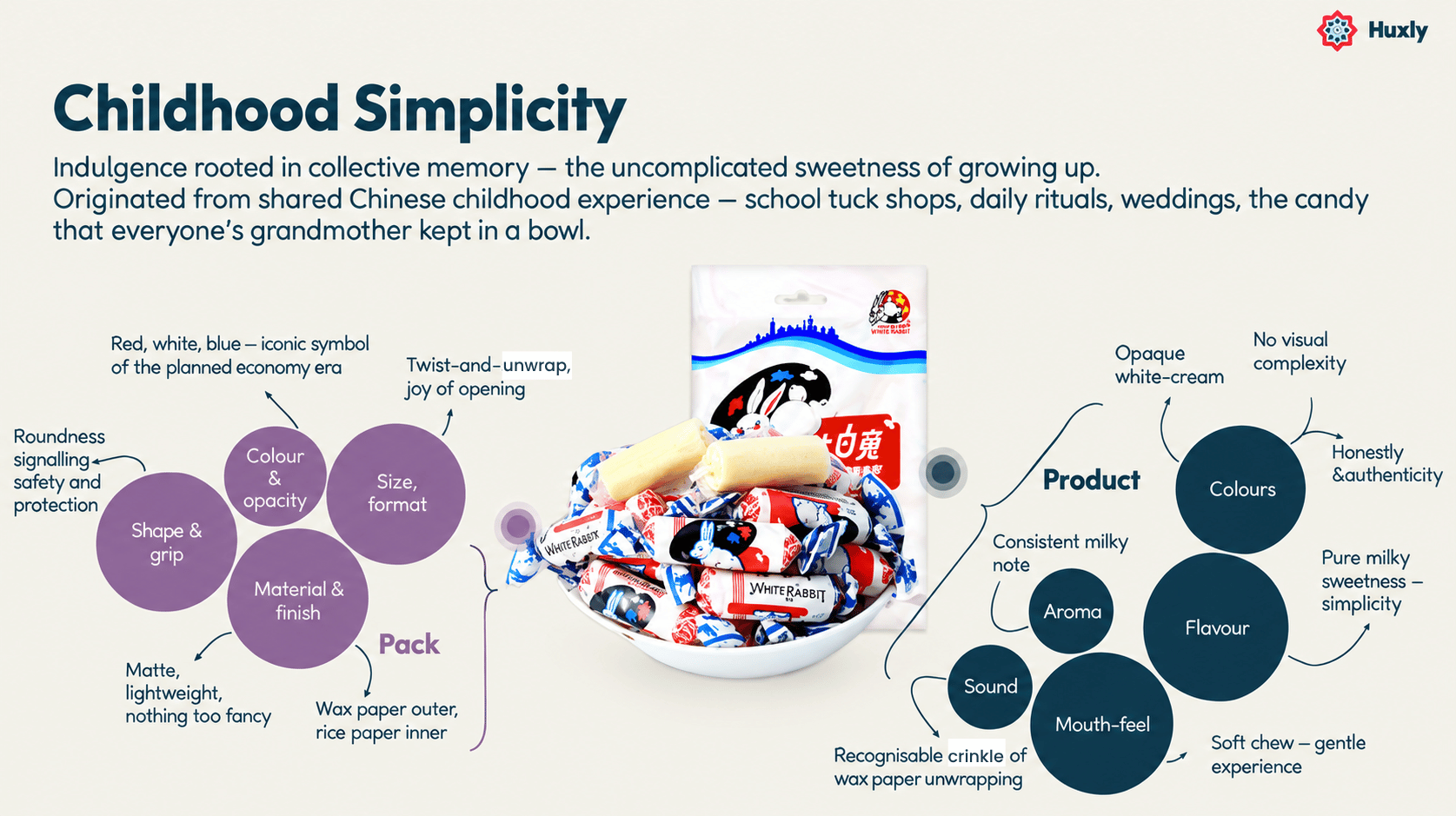
The starting code: White Rabbit’s chewy milky candy – a childhood staple for decades, where the ubiquity supports collective memory and uncomplicated indulgence
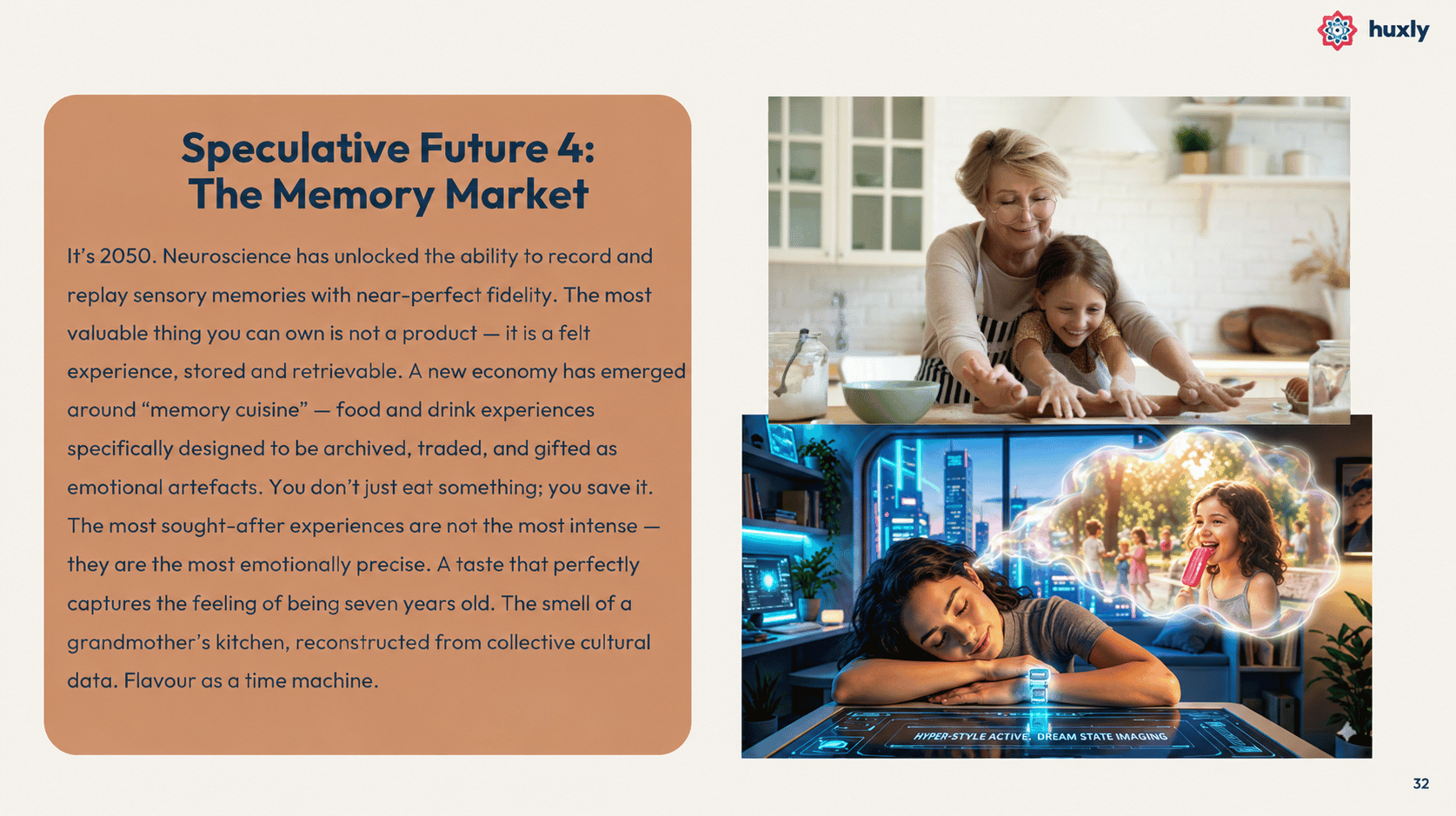
The chosen speculative world:
The proposed solution:
In a world where adults are fatigued by instant gratification, it’s effort that has become the escape, and re-engaging with physical sensation. White Rabbit’s chewy milky candy is trans-created into the ‘memory market’ reality not as an object of instant transformation and discovery, but rather a preservation of maternal connection. The effortful chew creates an earned reward into an analogue reality that makes you feel alive.
The takeaways from doing this exercise in person, with innovative Chinese snacks - with the perspectives of semioticians, brand strategists and sensory researchers – show how powerful it is to innovate with your body and mind at the same time. It allowed our intuition (rather than our rational innovation strategy brain) to guide the foundational sensory cues, and then our cultural & human engagement to complete the picture through ritual creation.
Please reach out if you’d like to see the full sensory semiotics report for Chinese indulgence snacking, or if you see the value in running a session like this with your team!